


b-arch designs an integrated project combining winery, dining and hospitality in the heart of Chianti
Nestled in the ordered and luminous landscape of the Chianti hills, just a few kilometres from Florence, Casa Ruffino takes shape within Tenuta Poggio Casciano as a layered and complex hospitality project, capable of interpreting the site’s historical memory through a contemporary language that is measured, aware and refined.
Commissioned to b-arch, the Florence-based studio founded by Sabrina Bignami and Alessandro Capellaro, the project was conceived with the aim of accompanying the evolution of the Ruffino brand over time, translating its identity and values into a unified spatial experience. Winery, guided tours and tasting routes, the Tre Rane Restaurant, the wine shop and the Wine Relais thus coexist within a single design vision, where production, storytelling and hospitality become parts of one coherent experience.
The distinctive character of the project also lies in the very nature of the intervention. More than a radical transformation, Casa Ruffino took shape as a deep restyling carried out with intentionally limited margins of freedom. The brief required the existing structure to be preserved almost in its entirety, despite the fact that it had undergone numerous alterations over time, many of them of limited architectural significance. b-arch’s task was therefore to turn this constraint into a design quality, intervening with almost surgical precision in order to restore coherence, identity and perceptual intensity to a heterogeneous whole.
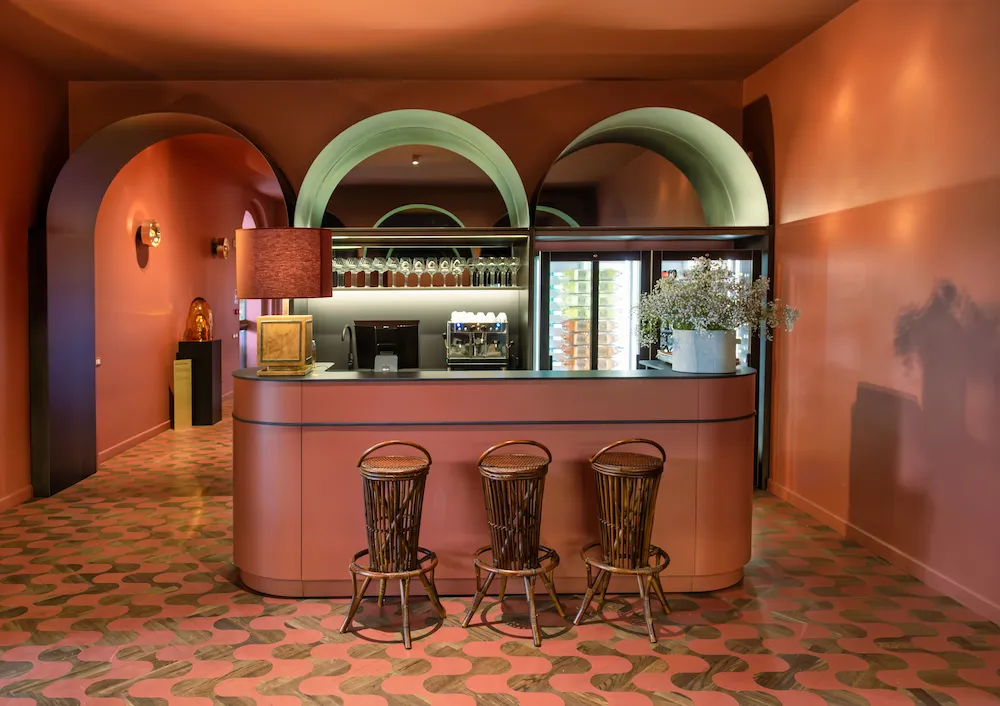
A precise idea—both cultural and spatial—guided the entire project: sprezzatura. In the Renaissance sense described by Baldassarre Castiglione and later revisited by Monsignor Giovanni Della Casa, sprezzatura is that subtle quality through which elegance appears natural, spontaneous, almost effortless. It is a grace that does not show itself, an elegance that never declares its own effort. It is also a deeply Italian quality: the ability to live beauty naturally, allowing aesthetics, culture and everyday life to coexist in an equilibrium that appears simple but is in fact highly sophisticated.
From this came the decision to move away from the most predictable iconography of the traditional winery. Rather than replicating the most recognisable codes of the wine world—the barrel as dominant image, the vat, the almost liturgical ritual of the sommelier—the project builds a different imaginary: more contemporary, more sensual, freer. It is an innovative language, yet one deeply rooted in Italian and Tuscan culture, drawing on iconic Italian design and intertwining it with a series of custom-made elements designed by b-arch. The result is a deliberately anti-rhetorical narrative of wine, one that does not deny tradition but rereads it through a more contemporary, more sensorial code, closer to the culture of design.
Within this framework, colour assumes a decisive role. With the exception of the rooms of the Wine Relais, the entire intervention is traversed by a deep chromatic note inspired by grape must, enveloping the visitor in an immersive and coherent experience. In the winery itself—the symbolic and productive heart of Ruffino—painting the space in this hue was the very first design gesture, a foundational move from which all subsequent interventions unfolded. From there, the colour extends into the tasting rooms, the wine shop, the Tre Rane Restaurant and the common areas, building a perceptual continuity that unifies different functions within one material and sensorial narrative.
Casa Ruffino thus takes shape as an immersive journey into the Ruffino world. Guided tours move through vineyards, historic rooms and production spaces, culminating in tastings where territory and oenological identity come together. The winery retains the force of its stone walls and large wooden barrels, enhanced by calibrated, raking light that emphasises the density of the surfaces without turning the productive space into a stage set. Here architecture works by subtraction, introducing raw iron details that affirm contemporaneity with discretion.
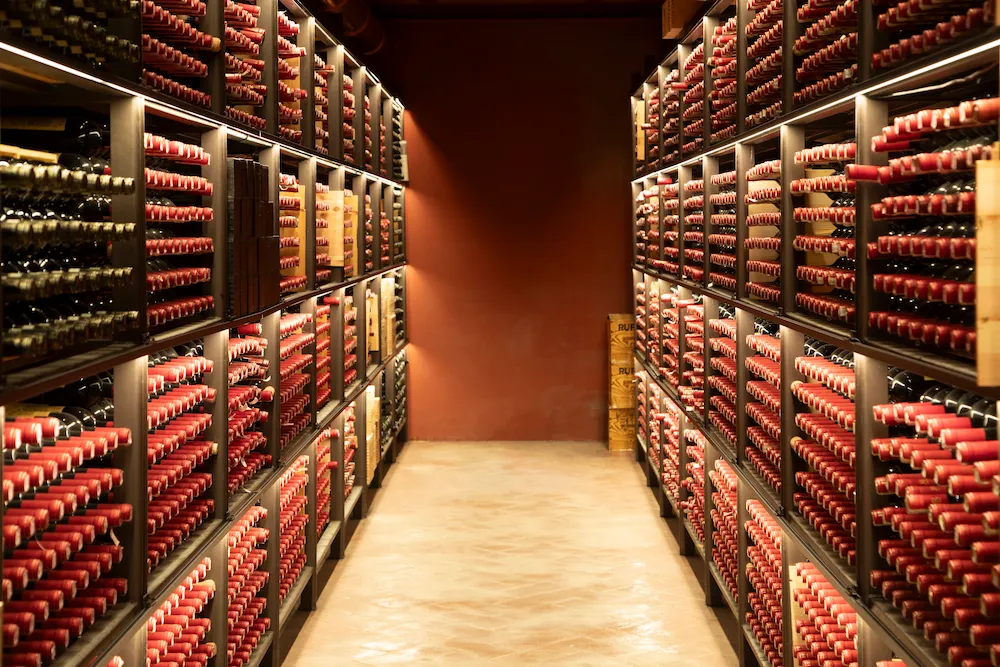
The Tre Rane Restaurant establishes a constant dialogue between cuisine and wine, reinterpreting Tuscan tradition through a contemporary sensibility that avoids any folkloric approach. The common rooms retain exposed beams, while the repainted parquet flooring with its geometric pattern and the controlled use of colour define a deep, enveloping atmosphere. Furnishings that combine contemporary design and vintage pieces act as mediators between heritage and the present, avoiding any museum-like effect and giving the spaces an authentically lived-in dimension. The wine shop completes the experience as a place where wine culture meets conviviality, transforming the bottles into an architectural and narrative presence.
The Wine Relais, housed within the Renaissance villa, welcomes guests into rooms conceived as intimate and measured spaces, where light, proportions and materiality generate a sense of continuity with the surrounding landscape. Here the palette becomes lighter, opening more fully to a dialogue with the vineyards and hills visible through the windows, in a constant visual and sensorial relationship between inside and outside.
Each compositional choice contributes to a unified and recognisable renewal, while preserving the historical value of the architectural structure. The interiors maintain the original layout of the rooms, enhancing period terracotta floors, exposed beams and historic surfaces that dialogue with contemporary materials. Raw iron—a recurring hallmark of the studio’s research—introduces an essential and tactile presence, capable of asserting contemporaneity with measure.
Ruffino’s identity emerges in a way that is recognisable yet never didactic. Colour, materiality, light and the rhythm of the spaces construct a coherent narrative that accompanies the visitor through the estate’s various functions, rooting the experience in the productive and symbolic context of wine.
Casa Ruffino thus goes beyond the conventional dimension of hospitality to become a cultural as well as architectural project: a place where architecture, interior design and brand identity intertwine in a subtle balance between memory and innovation, building long-term value through coherence, restraint and design depth.


